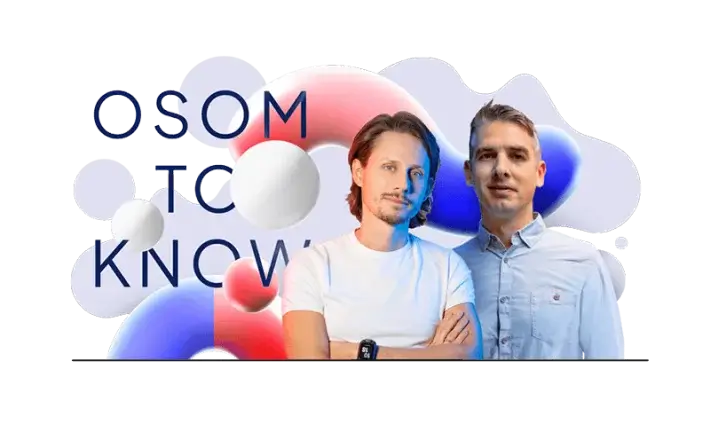
Being one step ahead of the WordPress core – Interview with Jakob Trost
Get a sneak peek with Maciej at what it’s like to work with the WordPress core team. With Jakob Trost from GREYD, they discuss the future of WP and the future of coding in the face of AI.
In this episode of Osom to Know, Maciej Nowak sits down with Jakob Trost – Head of Product at GREYD – to explore what it means to build tools that extend WordPress core while staying deeply aligned with its roadmap. The discussion unpacks full-site editing, design systems, and the evolving role of AI in WordPress development.
Jakob’s background bridges design and engineering. Originally trained in design, he transitioned into programming during his university years and has never looked back. That dual skillset shapes his product philosophy: great WordPress tools balance aesthetics, logic, and usability.
WordPress as a Culture of Contribution
WordPress core is more than a platform – it’s the beating heart of the open-source web. In our conversation, Jakob Trost emphasizes how the WordPress ecosystem thrives on collaboration, contribution, and continuous learning. As he explains, innovation in WordPress development happens when designers, developers, and contributors work together toward shared goals. His insights reveal how the community behind the WordPress core shapes the entire future of digital experience.
You can’t build great websites if design and development exist in separate silos.
This mindset translates into GREYD’s collaborative approach – empowering designers and developers to work together, not apart. Jakob adds that success lies in aligning creativity with structure, not dividing them.
Having a design mindset makes me think about structure differently – not just how it works, but how it feels to use.
Whether you’re a WordPress agency, plugin developer, or content strategist, Jakob offers a rare look into how innovation happens one step ahead of WordPress core.
How GREYD Stays One Step Ahead of WordPress Core Development
Jakob Trost makes it clear: GREYD doesn’t just build for WordPress. They build with it, often anticipating where the core team is heading. This balance – staying compatible while pushing boundaries – defines their approach.
We’re watching Trac tickets daily. But we also have to deliver product features now, so sometimes we solve problems ahead of the core team.
GREYD’s builder implemented full-site editing long before it became a native feature. When WordPress officially released FSE, GREYD quickly aligned with it, replacing custom logic with native functions.
When the core catches up, that’s a win – it means we were solving the right challenges at the right time.
Jakob calls this controlled evolution – building in sync with the ecosystem, not outside it. Every release demands rethinking architecture, updating compatibility, and helping customers transition smoothly.
From Freelance Development to a Scalable WordPress Product
Before founding GREYD, Jakob worked as a freelance developer using tools like Elementor and Divi. While they delivered beautiful results, he saw a problem: those systems created dependency instead of empowerment.
Clients could build beautiful sites, but they were locked into proprietary systems. We wanted something truly native.
GREYD was born from that frustration. The mission: make WordPress scalable without sacrificing freedom. The product extends Gutenberg instead of replacing it, giving agencies enterprise-level control with native compatibility.
The moment your tool stops being compatible with the core, you’re not part of WordPress anymore – you’re a closed ecosystem.
That philosophy helps GREYD build websites as living systems – scalable, editable, and future-proof.
Why WordPress Design Should Focus on Users, Not Developers
One of Jakob’s sharpest observations concerns a recurring WordPress pitfall: too many products are built for developers, not for actual users.
The people who build WP features often come from an engineering perspective. But site builders and business owners have very different needs.
GREYD’s UX-first strategy puts accessibility and simplicity above everything else. Most users, Jakob explains, don’t know what a “block” is – they just want to update their homepage without breaking anything.
A marketer doesn’t want ten options – they want one clear path that works every time.
GREYD’s internal rule reflects this: if it needs a tutorial, it’s already too complicated. This user-first mindset is what keeps WordPress accessible to everyone.
Adapting to Core Changes – GREYD’s Open-Source Philosophy
Operating ahead of the WordPress core comes with risks. What if WordPress introduces features you’ve already built? For GREYD, that’s a sign of success.
We see it as a success, not a threat. If the core adds what we already solved, it means we were working on the right problem.
GREYD’s approach keeps their platform light, adaptable, and community-aligned. Instead of fighting WordPress updates, they evolve faster.
We don’t fight the future – we adapt to it faster than most can plan for it.
This forward-thinking model helps them focus on enterprise needs like multi-site synchronization, design governance, and advanced asset management – areas where WordPress core still leaves room for innovation.
How AI Is Transforming WordPress Development
Jakob is pragmatic about AI’s growing role in coding. Tools like GitHub Copilot are not competition – they’re catalysts.
AI helps me get to the meaningful parts faster. I don’t need to write boilerplate anymore.
He sees AI as a tool that amplifies creativity by removing repetition. The future belongs to product engineers who combine technical skill with user empathy.
AI won’t replace developers, but it will replace the ones who refuse to use it.
Jakob believes that as AI automates syntax, developers must focus on structure, architecture, and value delivery. At Osom Studio, we’re seeing the same shift – AI speeds up production, but raises expectations for creativity and strategy.
The Future of WordPress: From Templates to Design Systems
The next evolution of WordPress, according to Jakob, is the shift from themes to design systems. GREYD’s approach embraces modularity over rigidity.
We’re trying to give power back to designers, while still keeping the structure that devs and clients need.
He envisions a near future where one universal theme could power all sites through pattern libraries and design tokens.
Themes will stop being boundaries and start being blueprints.
This design-system mindset marks WordPress’s transformation from a page builder to a product-building platform.
Beyond WordPress: The Rise of Low-Code, No-Code, and AI Builders
The conversation widens to the booming low-code and no-code ecosystem. Jakob sees it not as competition, but as inspiration.
A designer shouldn’t have to write code to express creativity. A marketer shouldn’t need a developer to launch a campaign.
He predicts a hybrid model: open-source platforms like WordPress integrating AI-driven features to stay relevant.
The next generation won’t code less – they’ll code differently.
That evolution ensures that WordPress remains the creative foundation for both developers and creators.
Inside the WordPress Core Community
GREYD collaborates closely with the WordPress core team – from Slack discussions to testing beta features.
Right now, we contribute through feedback and testing. We’re small, but active.
Jakob values the slow, deliberate pace of WordPress core development. GREYD’s role as an active observer allows them to bridge the gap between enterprise users and open-source maintainers.
The Developer’s Mindset: Systems Over Syntax
Jakob believes modern WordPress development is less about writing code and more about orchestrating systems.
Good code is invisible. Good systems stay relevant even when code changes.
This mindset pushes teams to think in relationships – data, design, and intent – rather than just deliverables. Every great product is a conversation between logic and empathy.

Key Takeaways from the Conversation
- Future-proof development: GREYD’s approach shows that anticipating WordPress core updates – not resisting them – is the fastest path to innovation. Staying agile and aligned with open-source evolution ensures long-term product stability.
- AI as a co-creator: Jakob views AI tools as partners that accelerate workflows and allow developers to focus on creative problem-solving rather than repetitive coding.
- Design systems over templates: WordPress’s next leap is about modular, reusable systems that empower designers and maintain brand consistency across projects.
- User-first philosophy: The most successful WordPress products remove friction for non-technical users. Jakob’s mantra, “If it needs a tutorial, it’s too complicated,” underscores the importance of intuitive UX.
- Collaboration is the core: From core contributors to product teams, community-driven innovation remains WordPress’s greatest competitive advantage.
Full conversation with Jakob Trost
Want to hear the full conversation with Jakob? Check out the latest 🎙️ Osom to Know podcast. You can also watch us on our YouTube – don’t forget to hit subscribe! 📩